
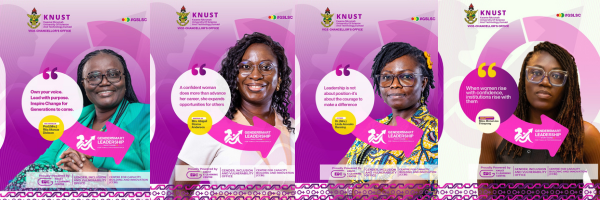

The KNUST E-Learning Centre has completed a three-day Gender Smart Leadership Short Course for Female Professionals aimed at helping women build leadership skills and advance their careers in higher education.
The programme brought together female academic staff, researchers, administrators and professional staff from KNUST and its affiliate institutions. It was held online from 23 to 25 June 2026.

The course was organised by the Gender, Inclusion and Vulnerability (GIV) Office, the Office of the Vice Chancellor and the KNUST E-Learning Centre.
It focused on helping participants understand the barriers women face in leadership and identifying practical ways to overcome them.
The programme opened with a session led by Prof. Pikay Richardson, who discussed leadership, gender discrimination in universities and ways women can build confidence, visibility and professional networks.

On the second and third days, participants joined separate sessions designed for academic staff and for administrative and professional staff.
This allowed discussions to focus on the different challenges faced by each group.
Topics covered during the course included leadership, career planning, research, administrative excellence, public engagement, networking and work-life balance.
Participants also discussed institutional policies, workplace culture and the need for greater support for women seeking leadership positions.
Several speakers shared their experiences and discussed the realities women face in universities. They included Prof. (Mrs.) Mercy Badu, Dr. Priscilla Addo Asamany, Dr. Lorraine Sallah, Prof. (Mrs.) Vivian Boamah and Ms. Eunice Akyereko Adjei. Their contributions linked research on gender inequality with experiences from working at KNUST.
The report on the programme identified a number of common themes. Participants were encouraged to seek opportunities instead of waiting to be invited, build strong professional networks, document their work and make their achievements visible. The discussions also stressed the role of university leaders in creating workplaces that support inclusion and equal opportunities.
The report recommends changes that could strengthen gender equality at the university. These include introducing flexible work arrangements for all staff, enforcing policies against harassment, ensuring gender-balanced recruitment and promotion panels, and recognising public engagement as part of academic performance.
It also calls for the Gender Smart Leadership Short Course to become an annual programme. The report recommends creating a follow-up platform where participants can share progress and support one another after the course. It further proposes that resource persons including Prof. Pikay Richardson, Prof. Ellie Perkins, Dr. Vincent Anum Ankamah Lomotey, Mr. Senyame and Prof. Margaret Japan should continue to support future editions of the programme and mentorship activities.
The report concludes that the programme provided participants with practical knowledge and created a platform for discussions on leadership and gender in higher education. It says the next step is to turn the ideas raised during the course into policies and actions that can support more women to take up leadership roles across the university.